THE DEVELOPMENT OF INTERACTIVE LEARNING CD IN CHEMISTRY FOR HIGH SCHOOLS BASED ON INTERTEXTUALITY AS A LEARNING MODEL ALTERNATIVE
DOI:
https://doi.org/10.18269/jpmipa.v16i2.36044Keywords:
intertextuality learning modelAbstract
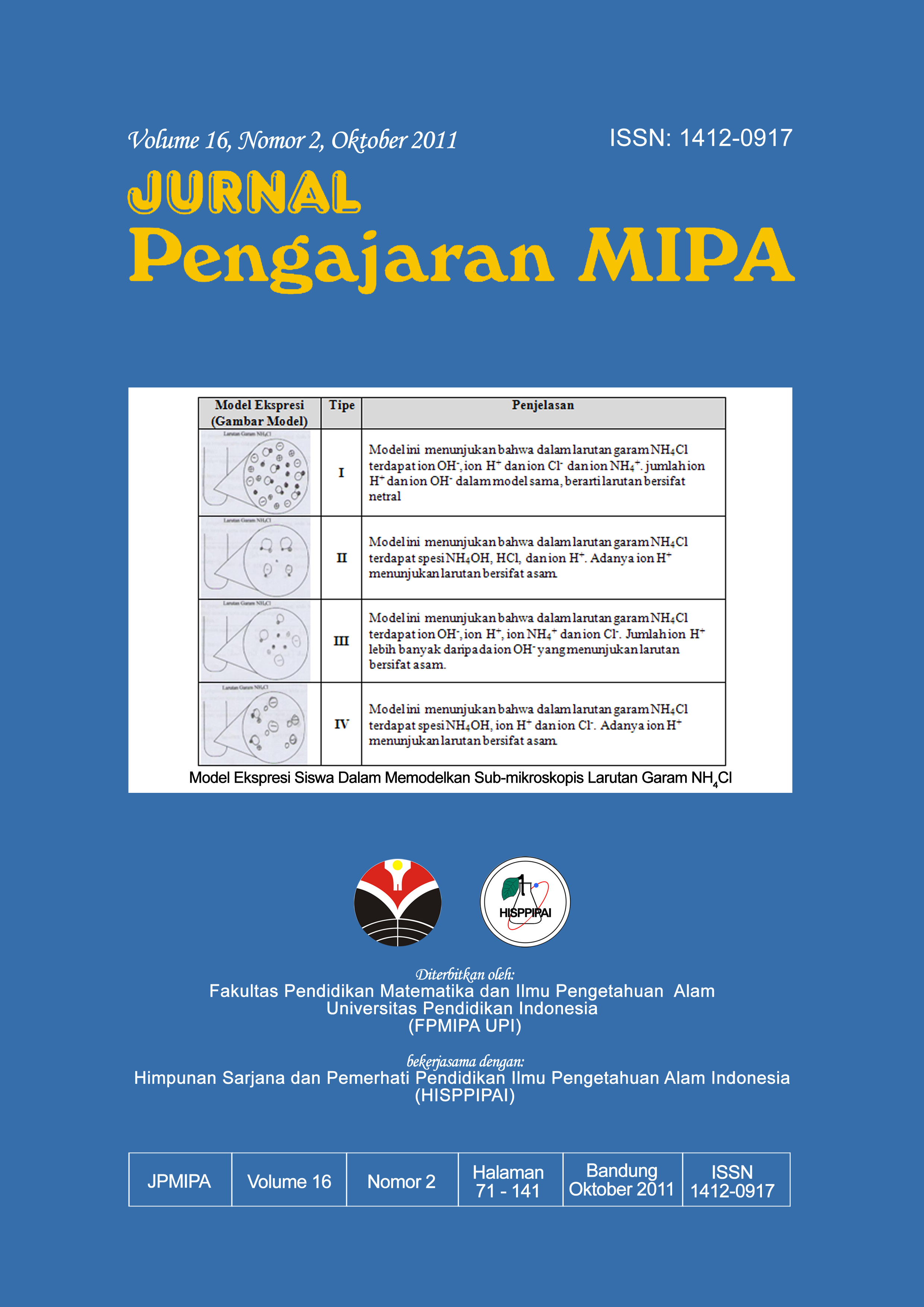
The study application of intertextuality learning model using the CD learning has been conducted in 3 high schools, SMA A, SMA B, and SMA C, during on May 2010. Selection of these three schools are expected to represent the school with low quality to high quality. During the process of learning trials take place, students can actively follow by providing a good response. From the displays are given, students can grasp the concepts of salt hydrolysis on the material well, although sometimes these views should be given back and forth for three levels of representation can link. In general, students responded well to the implementation of this intertextual learning strategy because it was interested in the learning process is done and easy to understand the concepts provided in a systematic and always connects with concepts already learned. The response of teachers towards the implementation of this intertextual learning model provides a positive outlook, in this case because the learning process undertaken to facilitate teachers to deliver material salt hydrolysis systematically arranged through third-level engagement representations and packaged in a multimedia form so that the concepts presented to received by students in one piece and easy. Application of learning models on material intertextual salt hydrolysis was able to improve the mastery of the concepts in the material. Increasing students' mastery of the concept of material obtained by hydrolysis salt N-gain value calculation, the overall values obtained N-gain of 0.67 which means the implementation of learning strategy on material intertextual hydrolysis of this salt can enhance the mastery of concepts with high criteria. This data also supported students' mental models for dissolution process of various salts. This model was also to increase student motivation in learning. Increased student motivation most high school students owned by C, which in most low pretest value compared other high school.
Downloads
References
Arikunto.2007. Prinsip-Prinsip Dan Teknik Evaluasi Pengajaran. Bandung: PT. Remaja Rosdakarya.Ben-Zvi, R., Eylon, B., & Silberstein, J. (1986). “Is an Atom of Copper Malleable?”. Journal of Chemical Education. 63, 64-66.
Ben-Zvi, R., Eylon, B., & Silberstein, J. (1987). “Students‟ Visualization of a Chemical Reaction”. Education in Chemistry. (7), 117-120.
Chittleborough, G.D., Treagust, D.F, dan Mocerino, M. (2002). Constraints to the development of first year university chemistry students’ mental models of chemical phenomena. [Online]. Tersedia: http://www.ecu.edu.au/conferences/tlf/2002/pub/docs/Chittleborough.pdf. [26 Juli 2007]
Depdiknas.2005.Peraturan Pemerintah RI No 19 Tahun 2005 tentang Standar Nasional Pendidikan, Jakarta: Depdiknas.
Depdiknas.2006. KTSP Mata Pelajaran Kimia untuk SMA, Jakarta: Depdiknas.
Firman, H.(1991).Penilaian Hasil Belajar Dalam Pengajaran Kimia.Bandung: IKIP
Hilton, Annette.2008. Scaffolding Chemistry Learning Within The Context Of Emerging Scientific Research Themes Through Laboratory.
Fatmawaty, E. (2001). Analisis Kesulitan Siswa dalam Memahami Materi Pelajaran yang Mengalami Reduksi Didaktik pada Pokok Bahasan Reaksi Reduksi dan Oksidasi. Skripsi pada Jurusan Pendidikan Kimia FPMIPA UPI: tidak diterbitkan.
Harlen, W. (1999). Effective Teaching of Science. Skotlandia: The Scottish Council for Reasearch in Education.
Holbrook, J.2005. Making Chemistry Teaching Relevant, Chemical Education International Vol 6. No 1 Agustus 2004.
Jansoon, N. 2008. Understanding Mental Models of Dilution in Thai Students,International Journal of Environmental & Science Education Vol 3. 147-168.
Keenan et al.1999.. Ilmu Kimia Untuk Universitas.(edisi ke 6).Alih bahasa: Alysius Hadyana Pujaatmaka. Jakarta:Erlangga.
Kuntjaraningrat.1997.Metode-metode Penelitian Masyarakat.Jakarta:PT. Gramedia
Osborne, R., & Freyberg, P. (1985). Learning in science: the impicaion of children’s science. Auckland, New Zealand: Heinemann Education.
Peraturan Menteri Pendidikan Nasional Republik Indonesia No. 22 Tahun 2006 Tentang Standar Isi untuk Satuan Pendidikan Dasar dan Menengah.
Park, Eung J.2006. Student Perception And Conceptual Development As Represented By Student Mental Models Of Atomic Structure . Disertasi: The Ohio StateUniversity
Sirhan, G.2007. Learning Difficulties in Chemistry: An Overview. Journal of Turkish science education. 4 (2).
Sanjaya, W. (2006). Strategi Pembelajaran Berorientasi Standar Proses Pendidikan. Jakarta: Kencana Prenada Media.
Sonata, M.S. (2006). Analisis Kesulitan Siswa dalam Memahami Materi Sub pokok Bahasan Faktor-Faktor yang Mempengaruhi Laju Reaksi yang Diolah dengan Reduksi Didaktik. Skripsi pada Jurusan Pendidikan Kimia FPMIPA UPI: tidak diterbitkan.
Wiji, (2003), Peranan Hiperteks dalam Meningkatkan Pelaksanaan TPB untuk menangani Konsep-konsep Rumit pada Perkuliahan Kimia Dasar I, Proyek Duelike
Wiji, (2005), CD Pembelajaran Kimia Dasar I Berbasis WEB untuk Mengatasi Kesulitan Mahasiswa Baru dalam Memetakan dan Memahami KonsepKonsep Dasar Kimia secara Integral, Proyek RII
Wiji, (2004), Peranan Modul Perkuliahan berbasis Komputer untuk mengungkapkan Fenomena Kimiawi pada Mata Kuliah Proses Pengolahan Air, Proyek SP4
Wu, H.-K. (2003). “Linking the microscopic view of chemistry to real life experiences: Intertextuality in a highschool science classroom”. Science Education. 87, 868-891.
Wu, H.-K., J. S. Krajcik, E. Soloway. (2000). Promoting Conceptual Understanding of Chemical Representations: Students‟ Use of a Visualization Tool in the Classroom.Makalah pada Pertemuan Tahunan the National Association of Research in Science Teaching 28 April-1 Mei 2000, New Orleans, LA.
Wu, H.K., Krajcik, J.S., dan Soloway, E. (2002). Promoting Conceptual Understanding of Chemical Representations: Students’ Use of a Visualization Tool in the Classroom. [Online]. Tersedia: http://hice.org/papers/2001/promoting_conceptual_understanding/Wu-NARST00.pdf. [31 Juli 2007]
Wang, Chia Yu.2007. The Role Of MentalModeling Ability, Content Knowledge, And Mental Models In General Chemistry Students’ Understanding About Molecular Polarity. Disertasi : University of Missouri
Weeradharwana, A.(2006). Use of Visualisation Software To Support Understanding of Chemical Equilibrium: The Importance of Appropriate Teaching Strategies.In ascilite 2006 Australian society for computers in learning in tertiary education 3-6 Desember 2006.
Wisya.2009. Impelementasi Model Siklus Belajar ’Suap’ Dengan Berbantuan Lks Dalam Upaya Meningkatkan Aktivitas Dan Hasil Belajar Siswa Kelas X SmaN 2 Negara Tahun Ajaran 2009/2010.[online].Tersedia:http:// wisya74.fileswordpress.com.2010/06/proposal_kab_i.doc.(28 Maret 2010).
Downloads
Published
Issue
Section
License

This work is licensed under a Creative Commons Attribution-ShareAlike 4.0 International License.


