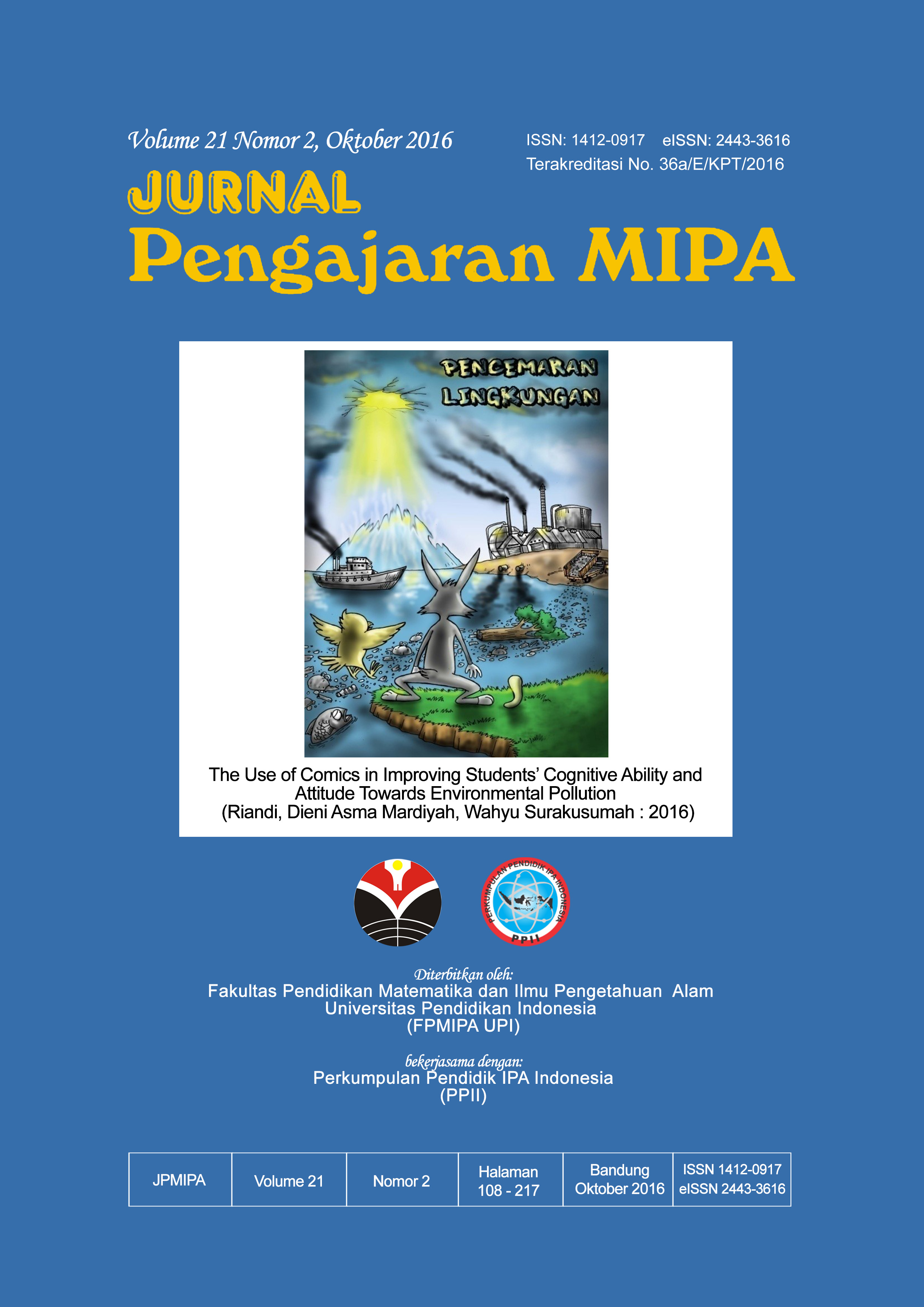
BUILDING UNDERSTANDING AND AWARENESS OF ENVIRONMENTAL POLLUTION THROUGH COMIC
DOI:
https://doi.org/10.18269/jpmipa.v21i2.57591Keywords:
comic, environment awareness, environmental pollution, learning preferences, komik, kesadaran lingkungan, polusi lingkungan, gaya belajarAbstract
Environmental problems such as widespread pollution are ongoing threats to the livelihood of the current and future generations. Engaging learning media such as comics can be used to instill the importance of understanding our role in solving environmental pollution problems. This paper reports the promising benefit of using comics in building junior high school students understanding and awareness of water, soil, dan air pollution. Comic is a visual medium, and whether students’ specific learning preferences play a role in learning results was also determined and discussed.
Masalah lingkungan seperti pencemaran merupakan ancaman berkelanjutan bagi kehidupan generasi saat ini serta generasi mendatang. Media pembelajaran yang menarik seperti komik dapat digunakan untuk menanamkan pentingnya memahami peran kita dalam menyelesaikan masalah pencemaran lingkungan. Artikel ini melaporkan manfaat yang menjanjikan dari penggunaan komik dalam membangun pemahaman dan kesadaran siswa sekolah menengah pertama tentang pencemaran air, tanah, dan udara. Komik adalah media visual, dan apakah gaya belajar siswa berperan dalam hasil belajar juga diukur dan didiskusikan.
Downloads
References
American Chemical Society. (2012). The Legacy of Rachel Carson’s Silent Spring. Washington, D.C.: American Chemical Society National Historic Chemical Landmarks Program.
Almigbal, T.H. (2015). Relationship between the learning style preferences of medical students and academic achievement. Saudi Medical Journal, 36(3), 349-55.
Andersson, B., & Wallin, A. (2000). Students’ understanding of the greenhouse effect, the societal consequences of reducing CO2 emissions and the problem of ozone layer depletion. Journal of Research in Science Teaching, 37(10), 1096–1111.
Aydin, G. (2015). The effects of computer-aided concept cartoons and outdoor science activities on light pollution. International Electronic Journal of Elementary Education, 7(2), 143-156.
Barrow, M. V. (2012). Carson in cartoon: a new window onto the noisy reception to Silent Spring. Endeavour, 36(4), 156–164.
Choi, S., Niyogi, D., Shepardson, D.P., Charusombat, U. (2009). Do Earth and Environmental Science Textbooks Promote Middle and High School Students' Conceptual Development About Climate Change? Textbooks' consideration of students' misconceptions. Bulletin of the American Meteorological Society, 91(7), 889–898.
Dimitriou, A., & Christidou, V. (2007). Pupils’ understanding of air pollution. Journal of Biological Education, 42(1), 24–29.
Espinosa A.A. (2013) Media cartoons: Effects on concept understanding in environmental education. World Journal of Environmental Research, 3(2), 13–32.
Farmer, J., Knapp, D., & Benton, G. M. (2007). An Elementary School Environmental Education Field Trip: Long-Term Effects on Ecological and Environmental Knowledge and Attitude Development. Journal of Environmental Education, 38(3), 33–42.
McNeill, K. L., & Vaughn, M. H. (2010). Urban High School Students’ Critical Science Agency: Conceptual Understandings and Environmental Actions Around Climate Change. Research in Science Education, 42(2), 373–399.
Myers, G., Boyes, E., & Stanisstreet, M. (2004). School students’ ideas about air pollution: knowledge and attitudes. Research in Science & Technological Education, 22(2), 133–152.
Reinfried, S., Aeschbacher, U., & Rottermann, B. (2012). Improving students’ conceptual understanding of the greenhouse effect using theory-based learning materials that promote deep learning. International Re-search in Geographical and Environmental Education, 21(2), 155–178.
Skamp, K., Boyes, E., & Stanisstreet, M. (2004). Students’ Ideas and Attitudes about Air Quality. Research in Science Education, 34(3), 313–342.
Small, E. (2016). The value of cartoons for biodiversity conservation. Biodiversity, 17(3), 106–114.
Stewart, J., & Clark, T. (2011). Lessons from South Park: A Comic Corrective to Environmental Puritanism. Environmental Communication, 5(3), 320–336.
Shurkin, J. (215). Science and Culture: Cartoons to better communicate science. PNAS, 112 (38) 11741-11742.
Toledo, M.A., Yangco, R.T., & Espinosa, A.A. (2014). Media Cartoons: Effects on Issue Resolution in Environmental Education. International Electronic Journal of Environmental Education, 4(1), 19-51.
Downloads
Published
Issue
Section
License

This work is licensed under a Creative Commons Attribution-ShareAlike 4.0 International License.


