Changes in Mathematics Learning Outcomes Following Active and Meaningful Learning in Grade XI
DOI:
https://doi.org/10.17509/j-mer.v7i2.1486Keywords:
Active and Meaningful Learning, active learning, mathematics learning outcomes, meaningful learningAbstract
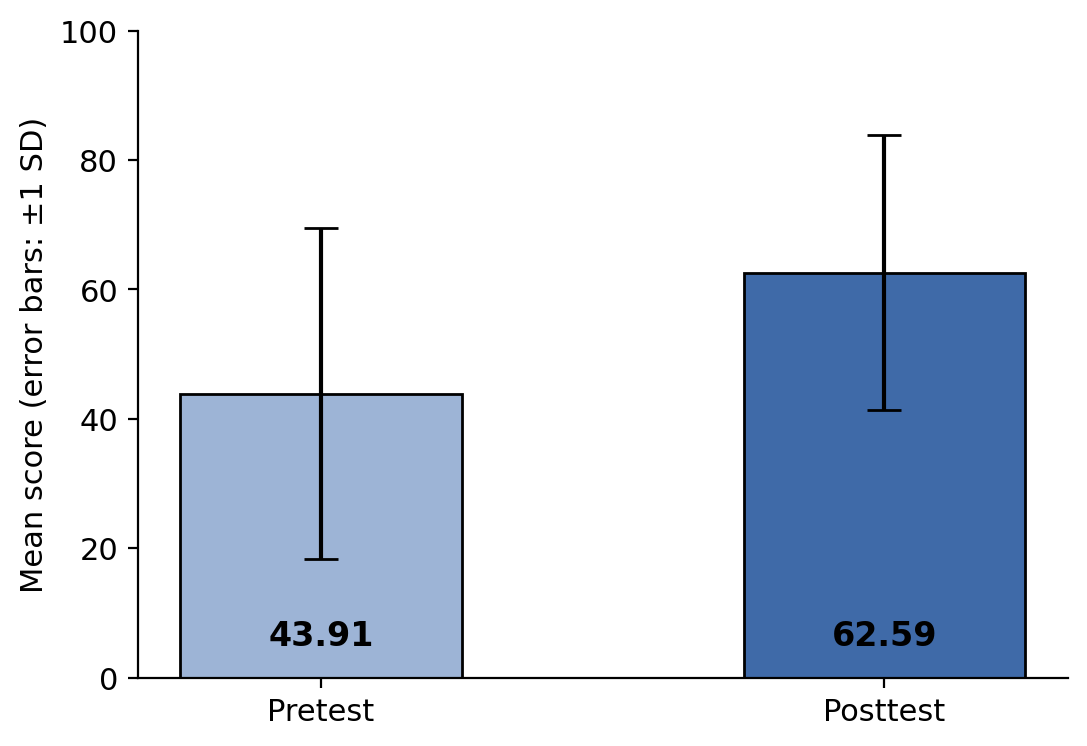
Students often find mathematics difficult because its concepts are abstract, so instruction needs to engage students actively and connect new concepts to prior knowledge. Active and Meaningful Learning (AML) combines active physical and mental engagement with the integration of new information into existing cognitive structures. Existing studies mostly examine active learning and meaningful learning separately, and little is known about the classroom implementation of AML with explicit stages. This study examined changes in Grade XI students' mathematics learning outcomes after AML instruction on relations and functions, algebraic operations on functions, and function composition. A quantitative, pre-experimental one-group pretest–posttest design was used. The participants were 32 students from one intact class assigned by the cooperating teacher from 12 Grade XI classes at a state senior high school in Indonesia. AML was implemented in five stages (engagement, active exploration, meaning construction, reflection, and evaluation) over six 90-minute meetings. Data were collected with an essay-based achievement test and analyzed with a paired-samples t-test after the normality of the difference scores was checked. The mean score increased from to Scores; therefore, it increased significantly after AML instruction. Because there was no control group, the class was not randomly assigned, and the equivalence of the parallel pretest and posttest forms was not tested, the increase cannot be attributed to AML with certainty. The findings document a classroom implementation of AML and suggest it merits further testing with comparison groups.
Downloads
References
Bonwell, C. C., & Eison, J. A. (1991). Active Learning: Creating Excitement in the Classroom. 1991 ASHE-ERIC Higher Education Reports. In ASHE-ERIC Higher Education Report. Washington, D.C.: The George Washington University, School of Education and Human Development.
Bryce, T. G. K., & Blown, E. J. (2024). Ausubel’ s meaningful learning re-visited. 43, 4579–4598. https://doi.org/https://doi.org/10.1007/s12144-023-04440-4
Campbell, D. T., & Stanley, J. C. (1963). Experimental and Quasi-Experimental Designs For Research. In Contemporary Psychology: A Journal of Reviews (Vol. 29, Number 4). https://doi.org/10.1037/022808
Cohen, J. (1998). STATISTICAL POWER ANALYSIS for the BEHAVIORAL SCIENCES. In Lawrence Erlbaum Associates (Vol. 8, Number 5).
Evendi, E. (2022). Encouragement of Active Learning Strategies in Mathematics Courses as an Effort to Improve Students’ Critical Thinking Skills. Prisma Sains: Jurnal Pengkajian Ilmu Dan …, 10(4), 890–898.
Ghasemi, A., & Zahediasl, S. (2012). Normality tests for statistical analysis: A guide for non-statisticians. International Journal of Endocrinology and Metabolism, 10(2), 486–489. https://doi.org/10.5812/ijem.3505
Irwan, A., & Murti, R. C. (2023). Pengaruh Model Meaningful Instruction Design dengan Pendekatan RME Terhadap Hasil Belajar Matematika Materi Pecahan. Jurnal Program Studi Pendidikan Matematika, 12(1), 636–644. https://doi.org/https://doi.org/10.24127/ajpm.v12i1.6292
Jean Piaget. (1952). The origins of intelligence in children. In Journal of Consulting Psychology. https://doi.org/10.1037/h0051916
John Dewey. (1938). Experience and Education. Collier Macmillan.
Jonassen, D. H., & Strobel, J. (2006). Modelling For Meaaningful Learning. Engaged Learning with Emerging Technologies, 1–27.
Koskinen, R., & Pitkaniemi, H. (2022). Meaningful Learning in Mathematics: A Research Synthesis of Teaching Approaches. International Electronic Journal of Mathematics Education, 17(2), em0679. https://doi.org/https://doi.org/10.29333/iejme/11715
Lakens, D. (2013). Calculating and reporting effect sizes to facilitate cumulative science: A practical primer for t-tests and ANOVAs. Frontiers in Psychology, 4, 1–12. https://doi.org/10.3389/fpsyg.2013.00863
Maulidiawati, Murtafiah, & Indrawati, N. (2022). Pengaruh Model Pembelajaran Aktif Type Quiz Team Terhadap Kemampuan Pemecahan Masalah Matematika. Jurnal Lebesgue : Jurnal Ilmiah Pendidikan Matematika, Matematika Dan Statistika, 3(3), 647–652.
NCTM (2000). Principles and standards for school mathematics. Author.
Nurahmah et al. (2024). Pengembangan Model Pembelajaran Active And Meaningful Learning (AML). Prosiding Seminar Nasional Lembaga Penelitian Dan Pendidikan (LPP) Mandala P-ISSN, (April), 1–6.
Polman, J., Hornstra, L., & Volman, M. (2021). The meaning of meaningful learning in mathematics in upper-primary education. Learning Environments Research, 24(3), 469–486. https://doi.org/https://doi.org/10.1007/s10984-020-09337-8
Shaadish, W. R., Cook, T. D., & Campbell, D. T. (2002). Experimental and Quasi-Experimental Designs For Generalized Causal Infeerence. In Dimensions in health service.
Shi, Y., Yang, H., MacLeod, J., Zhang, J., & Yang, H. H. (2019). College Students’ Cognitive Learning Outcomes in Technology-Enabled Active Learning Environments: A Meta-Analysis of the Empirical Literature. Journal of Educational Computing Research, 0(0), 1–27. https://doi.org/10.1177/0735633119881477
Vygotsky, L. S. (1978). Mind in society (Vol. 108, Numbers 3–4). Harvard University Press.