Analyzing Senior High School Students’ Mathematical Connection Ability in Solving HOTS Problems through AI-Assisted Learning
DOI:
https://doi.org/10.17509/j-mer.v7i2.1598Keywords:
AI, HOTS, Kemampuan Koneksi Matematika, PBLAbstract
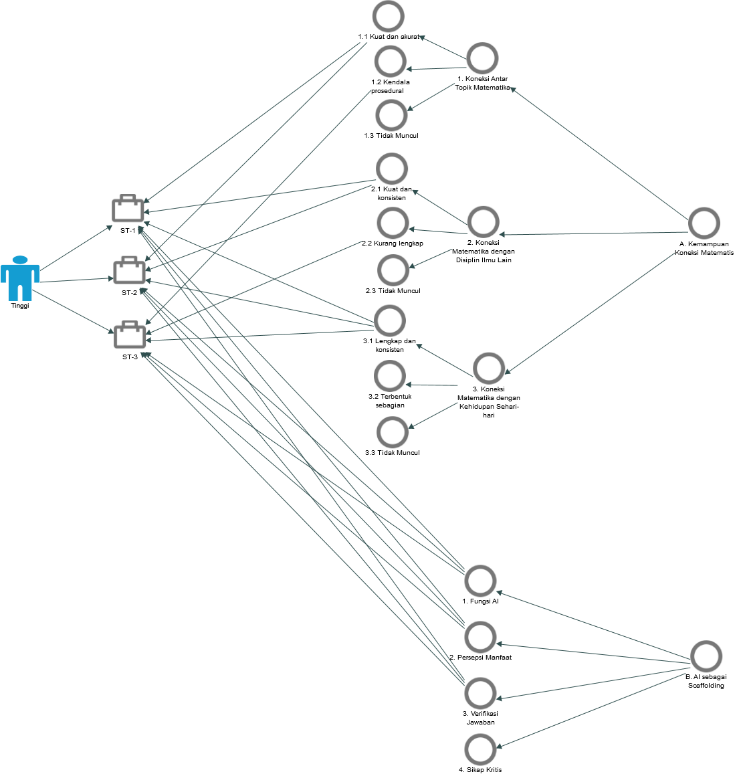
In the era of digital transformation, integrating technology into mathematics instruction remains a critical focus to enhance higher-level cognitive skills. This study is a qualitative research aimed at describing and analyzing high school students’ mathematical connection skills in solving Higher-Order Thinking Skills (HOTS) problems through Artificial Intelligence (AI)-assisted Problem-Based Learning (PBL) using ChatGPT, as viewed from high, medium, and low initial mathematical ability. The subjects were nine tenth-grade students at a public high school in Serang Regency, Indonesia, selected through purposive sampling and grouped into three initial ability categories. Data were collected using an initial ability test, classroom observations, a mathematical connection ability test featuring HOTS tasks, and semi-structured interviews. The results revealed that students with high initial ability fully mastered all three indicators of mathematical connections and effectively utilized AI as a reflective discussion partner. Students with medium initial ability demonstrated procedural mastery of connections and used AI to stimulate critical thinking. Conversely, students with low initial ability struggled to demonstrate written mathematical connections and could not leverage AI effectively without direct teacher guidance. The study concludes that AI-assisted PBL can facilitate mathematical connection skills depending on students’ initial ability, highlighting that AI integration must be carefully balanced with the teacher’s active role as a pedagogical facilitator.
Downloads
References
Aisyah, S., Juandi, D., & Jupri, A. (2022). Implementasi model problem based learning (PBL) terhadap kemampuan koneksi matematis siswa. AKSIOMA: Jurnal Program Studi Pendidikan Matematika, 11(2), 1009–1018. https://doi.org/10.24127/ajpm.v11i2.4728
Ausubel, D. P. (1968). Educational psychology: A cognitive view. Holt, Rinehart and Winston.
Campo-Meneses, K. G., Font, V., García-García, J., & Sánchez, A. (2021). Mathematical Connections Activated in High School Students’ Practice Solving Tasks on the Exponential and Logarithmic Functions. Eurasia Journal of Mathematics, Science and Technology Education, 17(9), 1–14. https://doi.org/10.29333/ejmste/11126
Creswell, J. W. (2012). Educational research: Planning, conducting and evaluating quantitative and qualitative research. Pearson.
Dao, X.-Q., & Le, N.-B. (2023). Investigating the effectiveness of ChatGPT in mathematical reasoning and problem solving: evidence from the vietnamese national high school graduation examination. Arxiv: Cornell University, 1–17. http://arxiv.org/abs/2306.06331
Doo, M. Y., Bonk, C. J., & Heo, H. (2020). A meta-analysis of scaffolding effects in online learning in higher education. International Review of Research in Open and Distributed Learning, 21(3), 60–80. https://doi.org/10.19173/irrodl.v21i3.4638
Halaweh, M. (2023). ChatGPT in education: Strategies for responsible implementation. Contemporary Educational Technology, 15(2), 1–11. https://doi.org/10.30935/cedtech/13036
Hasanuddin, M. I. (2020). Pengetahuan Awal (Prior Knowledge) : konsep dan implikasi dalam pembelajaran. EDISI : Jurnal Edukasi Dan Sains, 2(2), 217–232. https://ejournal.stitpn.ac.id/index.php/edisi
Hendrayana, A. (2017). Pengaruh pembelajaran pendekatan rigorous mathematical thinking (RMT) terhadap pemahaman konseptual matematis siswa SMP. Jurnal Riset Pendidikan Matematika, 4(2), 186–199. https://doi.org/10.21831/jrpm.v4i2.15385
Huang, X., Lo, C. K., He, J., Xu, S., & Kinshuk. (2024). Scaffolding-informed design of open educational resources in Chinese secondary school mathematics: insights from multi-cycle formative evaluation. Smart Learning Environments, 1–23. https://doi.org/10.1186/s40561-024-00337-2
Jailani, J., Sugiman, S., & Apino, E. (2017). Implementing the problem-based learning in order to improve the students’ HOTS and characters. Jurnal Riset Pendidikan Matematika, 4(2), 247–259. https://doi.org/10.21831/jrpm.v4i2.17674
Kemdikbudristek. (2022). Capaian pembelajaran mata pelajaran matematika fase a-fase f untuk SDLB, SMPLB, dan SMALB. In Kurikulum Kemdikbud.
Kemendikdasmen. (2025). Perencanaan pembelajaran mendalam. Pusat Kurikulum dan Pembelajaran.
Kurnila, V. S., Juniati, D., & Khabibah, S. (2023). Kemampuan koneksi dan berpikir kritis siswa SD dalam menyelesaikan soal cerita berdasarkan tahapan polya. AKSIOMA: Jurnal Program Studi Pendidikan Matematika, 12(1), 748–762. https://doi.org/10.24127/ajpm.v12i1.6428
Mataheru, E. E. (2024). Analisis kemampuan representasi dan koneksi matematis peserta didik dalam menyelesaikan soal kubus dan balok. Kognitif: Jurnal Riset HOTS Pendidikan Matematika, 4(4), 1780–1797. https://doi.org/10.51574/kognitif.v4i4.2739
Miles, M. B., & Huberman, A. M. (1994). Qualitative data analysis: an expanded sourcebook (2nd ed.). SAGE Publications.
Mone, P. S., Nenohai, J. M. H., & Samo, D. D. (2022). Kemampuan koneksi matematis siswa dalam pembelajaran matematika di tingkat SMP. Fraktal: Jurnal Matematika Dan Pendidikan Matematika, 3(1), 12–24. https://doi.org/10.35508/fractal.v3i1.5602
NCTM. (2000). Principles and standards for school mathematics. In The National Council of Teachers of Mathematics. www.nctm.org
Noviyana, H., Rahmawati, F., Kirana, A. R., & Tanod, M. J. (2025). Enhancing elementary students’ mathematical problem-solving skills through ai-assisted problem-based learning. Journal of Integrated Elementary Education, 5(2), 254–268. https://doi.org/10.21580/jie ed.v5i2.27576 K
OECD. (2023). PISA 2022 results (Volume I and II): Country notes - Indonesia. OECD Publishing.
Pambudi, D. S. (2020). Exploration of students mathematical connections with negative attitudes in solving a contextual geometry problem. Journal of Physics: Conference Series, 1663(1). https://doi.org/10.1088/1742-6596/1663/1/012031
Pramana, C. (2024). Belajar dan Pembelajaran di Abad 21 (A. Karim (ed.); 1st ed., Issue March). Penerbit Yayasan Kita Menulis.
Riinawati. (2021). Pengantar Evaluasi Pendidikan. Thema Publishing.
Rismawati, M., Rahmawati, P., & Rindiani, A. B. (2022). Analisis kemampuan berpikir tingkat tinggi dalam pemecahan masalah matematika berbasis higher order thinking skill (HOTS). Jurnal Cendekia : Jurnal Pendidikan Matematika, 6(2), 2134–2143. https://doi.org/10.31004/cendekia.v6i2.1444
Rumata, L. M., Afandi, A., & Hamid, H. (2022). Analisis kemampuan koneksi matematis siswa SMA kelas XI dalam menyelesaikan soal cerita terkait dengan materi matriks. Jurnal Pendidikan Guru Matematika, 2(2), 138–146. https://doi.org/10.33387/jpgm.v2i2.4628
Simanjuntak, D. A., Makmuri, & Rahayu, W. (2021). Problem-based learning: its effect on higher-order mathematical thinking skills in terms of student’s initial abilities and mathematical beliefs. Al-Jabar: Jurnal Pendidikan Matematika, 12(2), 457–466. http://doi.org/10/24042/ajpm.v12i2.10137
Stylianides, A. J., & Stylianides, G. J. (2007). Learning mathematics with understanding: a critical consideration of the learning principle in the principles and standards for school mathematics. The Montana Mathematics Enthusiast, 4(1), 103–114. https://doi.org/10.54870/1551-3440.1063
Sutrisno, J., Pratama, E. Y., R, A. P., Nasution, S. H., & Lestyanto, L. M. (2025). Students’ mathematical justification abilities in analyzing ChatGPT’s answers. Infinity: Journal of Mathematics Education, 14(2), 445–460. https://doi.org/10.22460/infinity.v14i2.p445-460
Sweller, J. (1988). Cognitive Load During Problem Solving : Effects on Learning. 285, 257–285. https://doi.org/10.1207/s15516709cog1202
Vasconcelos, M. A. R., & Santos, R. P. dos. (2023). Enhancing STEM Learning with ChatGPT and Bing Chat as objects-to-think-with: a case study. 167–186. https://arxiv.org/abs/2305.02202
Vygotsky. L.S. (1978). Mind in society: the development of higher psychological processes. Harvard University Press.
Yin, R. K. (2013). Studi kasus: desain dan metode (M. D. Mudzakir, Penerj.). Rajawali Pers.
Yuni, Y., Kusuma, A. P., & Huda, N. (2021). Problem-based learning in mathematics learning to improve reflective thinking skills and self-regulated learning. Al-Jabar : Jurnal Pendidikan Matematika, 12(2), 467–480. https://doi.org/10.24042/ajpm.v12i2.10847