Improving Grade II Fraction Learning Outcomes through Problem-Based Learning Assisted by Folded Paper
DOI:
https://doi.org/10.17509/j-mer.v7i2.1633Keywords:
classroom action research, folded paper media, fractions, learning outcomes, problem-based learningAbstract
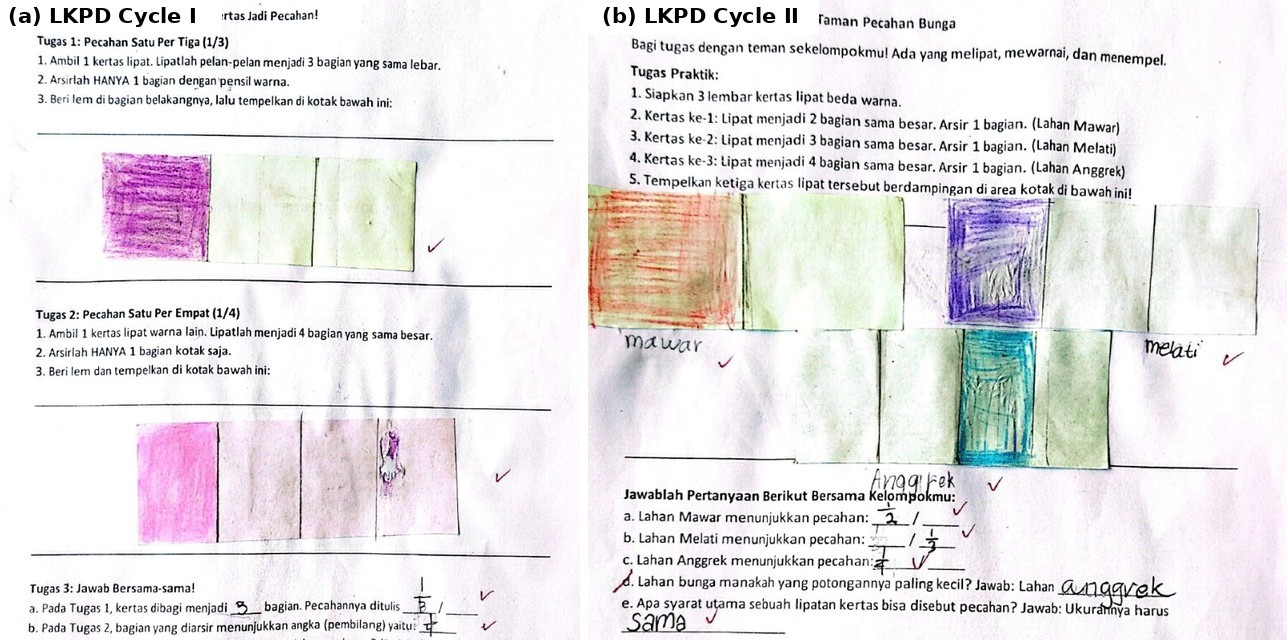
Mathematics learning outcomes on fractions among lower-grade primary students are often hindered by lecture-based instruction that requires them to grasp abstract concepts without concrete experience. This study aimed to describe the implementation of folded paper media through the Problem-Based Learning (PBL) model to improve students’ learning outcomes on simple fractions. This classroom action research, following the Kemmis and McTaggart model, was carried out in two cycles of one meeting each, preceded by a pre-cycle stage, with 29 Grade II students at a public elementary school in Bandung. Data were collected through tests, observations of teacher and student activities, and documentation. Data were analyzed using quantitative and qualitative techniques. Quantitative data were analyzed using descriptive statistics, while qualitative data were analyzed through data collection, data reduction, data presentation, and the drawing of conclusions and verification. The results indicate that the class average score increased from 58 in the pre-cycle to 72 in Cycle I and 86 in Cycle II. At the same time, classical mastery rose from 34.5% to 68% and 89.6%, exceeding the 80% success indicator. In Cycle I, grouping students into six large groups allowed some students to dominate the work and produced less symmetrical folds. Improvements in Cycle II, namely eight smaller groups, more intensive guidance, and the contextual “Fraction Garden” project, supported the gains. These findings indicate that combining folded paper as a manipulative with PBL can improve lower-grade students’ fraction learning outcomes and offers teachers a simple, inexpensive instructional alternative.
Downloads
References
Afiani, K. D. A., & Faradita, M. N. (2022). Pemahaman konsep matematika siswa kelas III di sekolah dasar Surabaya materi pecahan berbantu media folding paper. Jurnal Gentala Pendidikan Dasar, 7(1), 89–97. https://doi.org/10.22437/gentala.v7i1.17862
Astuti, P. H. M., Bayu, G. W., & Aspini, N. N. A. (2021). Penerapan model pembelajaran Problem Based Learning untuk meningkatkan hasil belajar matematika siswa. Mimbar Ilmu, 26(2). https://doi.org/10.23887/mi.v26i2.36105
Carbonneau, K. J., Marley, S. C., & Selig, J. P. (2013). A meta-analysis of the efficacy of teaching mathematics with concrete manipulatives. Journal of Educational Psychology, 105(2), 380–400. https://doi.org/10.1037/a0031084
Heruman. (2018). Model pembelajaran matematika di sekolah dasar. PT Remaja Rosdakarya.
Hmelo-Silver, C. E. (2004). Problem-based learning: What and how do students learn? Educational Psychology Review, 16(3), 235–266. https://doi.org/10.1023/B:EDPR.0000034022.16470.f3
Kustandi, C., & Darmawan, D. (2020). Pengembangan media pembelajaran: Konsep & aplikasi pengembangan media pembelajaran bagi pendidik di sekolah dan masyarakat. Kencana. https://books.google.co.id/books?id=cCTyDwAAQBAJ
Lestari, K. E., & Yudhanegara, M. R. (2017). Penelitian pendidikan matematika. Refika Aditama.
Miles, M. B., Huberman, A. M., & Saldan a, J. (2014). Qualitative data analysis: A methods sourcebook (3rd ed.). SAGE Publications.
Mulyasa, E. (2013). Menjadi guru profesional: Menciptakan pembelajaran kreatif dan menyenangkan. PT Remaja Rosdakarya.
Nofita, H. (2024). Meta analisis pengaruh model pembelajaran Problem Based Learning terhadap hasil belajar matematika. Martyvel: Jurnal Pendidikan dan Pembelajaran, 1(2), 62–69. https://doi.org/10.33084/martyvel.v1i2.7517
Octaviana, A., Nuryani, P., & Robandi, B. (2018). Penerapan model Problem Based Learning (PBL) untuk meningkatkan hasil belajar matematika siswa kelas III sekolah dasar. Jurnal Pendidikan Guru Sekolah Dasar, 3(3). https://doi.org/10.17509/jpgsd.v3i3.20745
Purwanto, N. (2017). Prinsip-prinsip dan teknik evaluasi pengajaran. PT Remaja Rosdakarya.
Ramadhani, D. M., Abira, A., & M, I. (2023). Meningkatkan hasil belajar matematika dalam materi pecahan menggunakan metode Problem Based Learning (PBL) di sekolah dasar. Jurnal DIDIKA: Wahana Ilmiah Pendidikan Dasar, 9(1), 218–228. https://doi.org/10.29408/didika.v9i1.15166
Santoso, J. T. B., & Widiyanti, A. (2022). Evaluasi hasil belajar ranah kognitif, afektif, dan psikomotor pada pembelajaran sinkronus dan asinkronus: Meta-analisis. TEACHING: Jurnal Inovasi Keguruan dan Ilmu Pendidikan, 3(4). https://doi.org/10.51878/teaching.v3i4.2695
Shoimin, A. (2017). 68 model pembelajaran inovatif dalam kurikulum 2013. Ar-Ruzz Media.
Sundayana, R. (2018). Media dan alat peraga dalam pembelajaran matematika. Alfabeta.
Susanto, A. (2013). Teori belajar dan pembelajaran di sekolah dasar. Kencana Prenada Media Group.
Taspiah, S., Hasan, K., & Alamsyah, H. (2021). Penerapan model Problem Based Learning meningkatkan hasil belajar matematika siswa SD. Pinisi Journal Pendidikan Guru Sekolah Dasar, 1(2). https://doi.org/10.70713/pjp.v1i2.26299
UNESCO. (2015). Rethinking education: Towards a global common good? UNESCO. https://unesdoc.unesco.org/ark:/48223/pf0000232555
Yuliandari, R. N., Anggraini, D. M., Rahmah, U. N., Zahroo, F., & Fatmawati. (2024). Peningkatan pemahaman konsep pecahan siswa sekolah dasar dengan media kertas lipat. Dawuh Guru: Jurnal Pendidikan MI/SD, 4(1), 93–102. https://doi.org/10.35878/guru.v4i1.1085
Zahro, F., Wahyudi, W., & Salimi, M. (2024). Penerapan model Problem Based Learning (PBL) dengan media konkret untuk meningkatkan pembelajaran matematika tentang pecahan pada peserta didik kelas II di SD Negeri 1 Gemeksekti tahun ajaran 2023/2024. Kalam Cendekia: Jurnal Ilmiah Kependidikan, 12(3). https://doi.org/10.20961/jkc.v12i3.86099