Peer Review Process
All submitted manuscripts undergo a rigorous peer-review process. The journal publishes only articles that have been evaluated and approved by qualified experts in the relevant field (a minimum of two reviewers per article).
JEM implements a double-blind peer review system, in which the identities of both authors and reviewers remain confidential throughout the review process.
The overall workflow from manuscript submission to the final editorial decision is illustrated in the figure below.
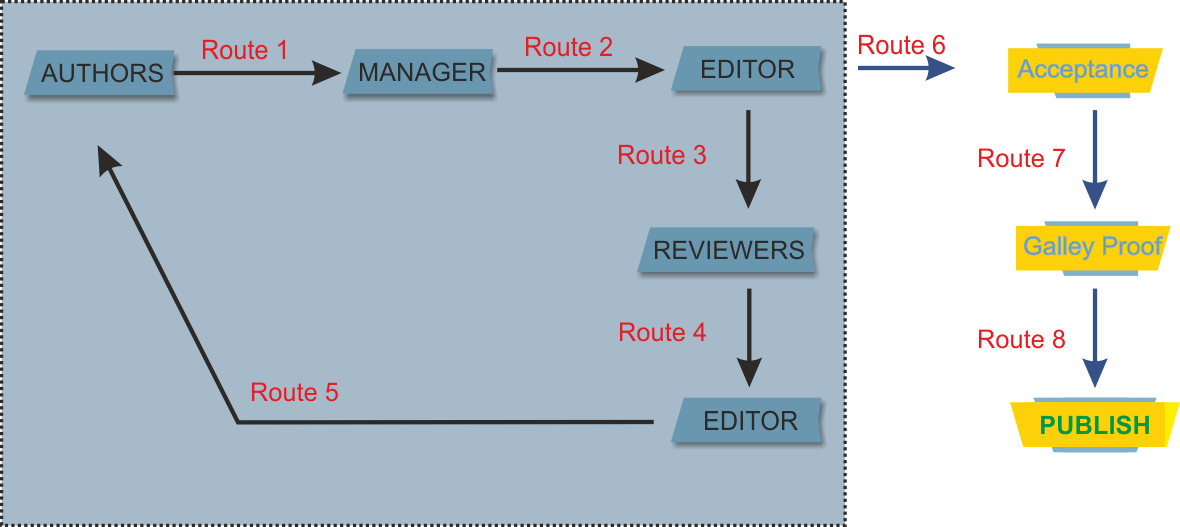
Peer Review Workflow
The manuscript evaluation process generally follows these steps:
- Manuscript Submission (Route 1)
Authors submit their manuscripts through the journal’s online submission system. - Initial Screening and Selection (Route 2)
The editorial team evaluates the manuscript to ensure it fits the journal’s scope, formatting requirements, and minimum quality standards. At this stage, the editor may directly accept, reject, or forward the manuscript for peer review. A plagiarism screening using Turnitin is also conducted. - Peer Review Process (Routes 3–4)
The manuscript is evaluated by at least two independent reviewers. Reviewers assess the originality, methodology, clarity, and contribution of the research and provide recommendations to the editor. - Editorial Decision (Route 5)
Based on reviewers’ comments and recommendations, the editor informs the author whether the manuscript is accepted, requires revision, or is rejected. - Manuscript Revision
If revisions are requested, the author must revise the manuscript according to the reviewers’ and editor’s comments and resubmit the revised version. - Revision Evaluation
The revised manuscript may be sent back to the reviewers for further evaluation. This process may continue until both reviewers and the editor are satisfied with the manuscript. - Final Acceptance (Route 6)
Once the manuscript meets the journal’s requirements, the editor issues the formal acceptance decision. - Galley Proof and Publication (Routes 7–8)
The accepted manuscript enters the production stage, including layout editing, proofreading, and final publication.
Steps 1–5 represent one round of the peer-review process. In most cases, manuscripts undergo at least two rounds of review before a final decision is reached.
Editorial Decisions
After considering the reviewers’ feedback, the editor may reach one of the following decisions:
- Accept without revisions – The manuscript is accepted and will be published in its current form.
- Accept with minor revisions – The manuscript is accepted subject to minor corrections by the author.
- Accept with major revisions – The manuscript will be accepted after substantial revisions suggested by the reviewers and editors are completed.
- Revise and resubmit – The manuscript requires significant changes and may be reconsidered in another review round.
- Reject – The manuscript does not meet the journal’s standards and will not be reconsidered for publication.
