Students’ Responses to the 7E Learning Cycle Model Integrated with the Inquiring Minds Want to Know Strategy for Developing Mathematical Representation Ability: A Descriptive Study
DOI:
https://doi.org/10.17509/j-mer.v7i2.1492Keywords:
7E Learning Cycle, Inquiring Minds Want to Know, Mathematical representation ability, students’ responsesAbstract
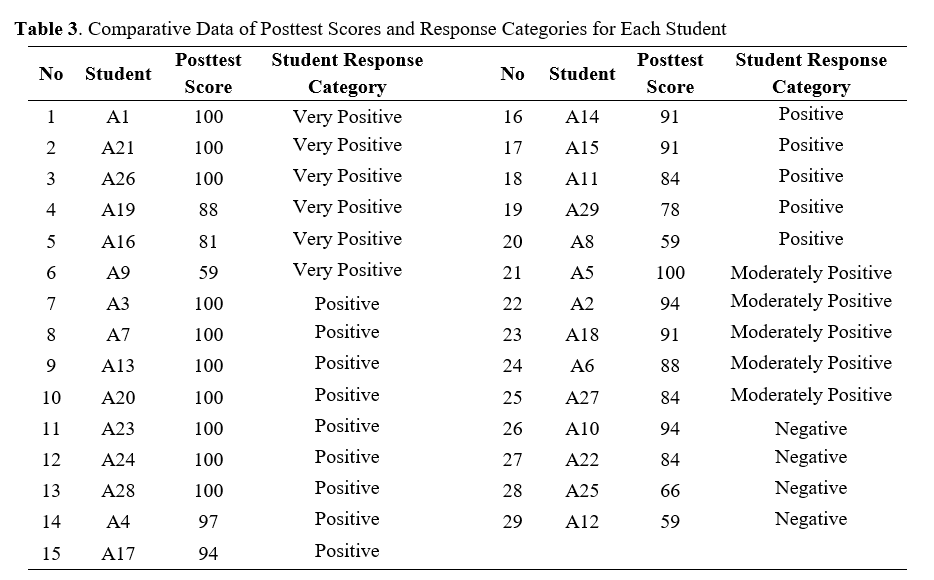
This study aims to analyze student responses to the implementation of the 7E Learning Cycle model integrated with the Inquiring Minds Want to Know strategy, and to descriptively examine the alignment between these responses and the post-test results regarding students' mathematical representation abilities. Data were derived from a quasi-experimental study involving two Grade 8 classes at a public junior high school in Bandung, Indonesia, with the analysis focusing on the 29 students in the experimental class. Student responses were collected through questionnaires and analyzed descriptively, while post-test scores served as supporting data to identify patterns aligned with student responses. The results indicate that most students responded positively to the instruction. The activities within the 7E Learning Cycle stages and the Inquiring Minds Want to Know strategy gave students opportunities to express ideas, explore concepts, and use various forms of mathematical representation. Overall, the positive student responses showed a pattern consistent with the post-test results. Although a few students showed a discrepancy between their overall response scores and post-test results, their responses to questionnaire indicators related to mathematical representation abilities aligned with the post-test outcomes. These findings suggest that the instruction generally elicited a positive response and fostered student engagement in mathematical representation activities.
Downloads
References
Cherono, J., Dinah, S., & Kabesa, S. (2021). Effect of 7E learning cycle model on students’ academic achievement in biology in secondary schools in Chesumei subcounty, Kenya. African Journal of Education, Science and Technology (AJEST), 6(3), 312.
Daulay, A. P., & Siregar, B. H. (2026). Pengembangan bahan ajar berbasis pendekatan terpadu untuk meningkatkan kemampuan literasi matematis siswa kelas VIII SMP IT Nurul Fadhilah. Jurnal Dunia Pendidikan, 6(5), 2219–2237.
Hany, B. A., & Setyaningsih, N. (2021). The influence of learning media, learning motivation and mathematics communication on mathematics learning outcomes. Journal of Mathematics and Mathematics Education, 12(1), 44-51.
Harahap, A. Y. A., Surya, E., & Syahputra, E. (2018). Differences between mathematics representation ability and students’ self-efficacy by using learning cycle 7E and discovery learning based on Batak Angkola culture in SMAN 1 Sipirok. American Journal of Educational Research, 6(11), 1497-1504.
Harefa, D. (2023). The relationship between students' interest in learning and mathematics learning outcomes. Afore: Jurnal Pendidikan Matematika, 2(2), 1-11.
Hariyani, M. et al. (2023). The importance of mathematical representation ability for elementary school students: a literature review and its implications. In Syekh Nurjati International Conference on Elementary Education (Vol. 1, pp. 38-46).
Inganah, S., Darmayanti, R., & Rizqi, N. (2023). Problems, solutions, and expectations: 6C integration of 21st century education into learning mathematics. JEMS (Journal of Mathematics and Science Education), 11(1), 220-238.
Isma, S., Putra, R., & Dewi, N. (2026). Pengembangan media pembelajaran berbasis website google sites berbantuan game wordwall berorientasi kemampuan pemahaman konsep matematis siswa SMP. Jurnal Cendekia: Jurnal Pendidikan Matematika, 10(3), 1475-1485.
Komariah, L., Salsabila, E., & Wiraningsih, E. D. (2021). Perbandingan antara model pembelajaran learning cycle 7E berbantuan media pembelajaran powerpoint, geogebra, dan LKS terbimbing terhadap kemampuan representasi matematis siswa di SMPN 2 Pamijahan Bogor. J-PiMat, 3(2), 385-394.
Leon, S.P. & Lipnevich, A. (2026). Tracking calibration and confidence: continuous and group-based insights from two high-stakes exams. Educational Assessment, Evaluation and Accountability.
Mataheru, E., Ratumanan, T. G., & Ayal, C. S. (2021). Analisis kemampuan representasi matematis peserta didik pada materi program linear. Jurnal Pendidikan Matematika (JUPITEK), 4(2), 55–67.
Musfiroh, M., Suwarma, I. R., & Efendi, R. (2024). Enhancing physics learning through the 7E learning cycle model: A systematic literature review. Indonesian Journal of Science and Mathematics Education, 7(3), 531-544.
Nurfallah, M., & Pradipta, T.R. (2021). Motivasi belajar matematika siswa sekolah menengah selama pembelajaran daring di masa pandemi covid-19. Jurnal Cendekia: Jurnal Pendidikan Matematika, 5(3), 2425-2437.
Nurochmah, Arifin, S., & Surgandini, A. (2021). The application of learning cycle 7E model to improve a mathematics communication skills of junior high school students. In AIP Conference Proceedings (Vol. 2331, No. 1, p. 020001). AIP Publishing LLC.
Raemy, U. E. et al. (2026). Predicting academic performance by self-assessed and objectively measured understanding and self-efficacy. Educational Psychology, 46(3), 396–415.
Rainuny, H. J., Laurens, T., & Huwaa, N. C. (2026). Efektivitas pembelajaran aljabar melalui pendekatan Realistic Mathematics Education (RME) pada siswa SMP. Jurnal Pendidikan Matematika Unpatti, 7(1), 56-62.
Resweda, C., Dewi, S. E. K., & Kholidin, N. (2025). Pengaruh strategi inquiring minds want to know terhadap hasil belajar peserta didik. Al-Misbah (Jurnal Prodi PGMI), 11(1), 1-13.
Rofiq, E., Rochmad, R., & Cahyono, E. (2021). Students’ mathematical representation ability in word problems with learning cycle 7E based on cognitive style. Unnes Journal of Mathematics Education Research, 10(2), 163–170.
Sachdeva, S., & Eggen, P. O. (2021). Learners’ critical thinking about learning mathematics. International Electronic Journal of Mathematics Education, 16(3).
Supriyatna, D., & Ashfiya, D. N. (2026). Stigma negatif terhadap mata pelajaran matematika dan dampaknya pada proses pembelajaran: tinjauan literatur sistematis. Advances In Education Journal, 2(5), 135-140.
Yuhasriati, Y. et al. (2022). Students mathematical representation ability in learning algebraic expression using realistic mathematics education. Jurnal Didaktik Matematika, 9(1), 151-169.